FLAME Study
Despite a higher global incidence of P. falciparum, P. vivax is the predominant species in many low transmission settings outside of Africa and a major challenge to malaria elimination due to hidden reservoirs of infections in the community. For instance, in the Peruvian Amazon, P. Vivax accounts for most (82.5%) of malaria infections (1). As an alternative to screening and treatment (SAT) or active case detection (ACD), mass drug administration (MDA), using effective radical cure regimens, is likely to decrease P. Vivax transmission. The World Health Organization (WHO) has released guidance on MDA for P. falciparum elimination; however, there is a lack of research regarding the safety and efficacy of an MDA program to reduce the P. Vivax malaria burden. The FocaL mass drug Administration for Plasmodium vivax malaria Elimination (FLAME) study aims to fill this gap. FLAME is a 3-year open-label cluster-randomized controlled trial in the Loreto Department, Peru. The FLAME trial has two arms: 1) a control arm, which receives standard malaria control interventions and 2) a treatment arm, in which individuals who are at high-risk of malaria receive focal mass drug administration (fMDA) in 3 cycles with two rounds per cycle in addition to the standard malaria control interventions. FLAME’s three main aims are:
- To determine the effectiveness of fMDA to reduce P. Vivax transmission
- To evaluate the safety and tolerability of fMDA
- To measure the cost-effectiveness and acceptability of fMDA
As of August 2026, the FLAME team had successfully enrolled 30 study communities with a total sample size of 4843 participants. Among the 4755 individuals screened in Arm A, 2763 were successfully enrolled, with an average of 184 participants per village. Among the 3254 individuals screened in Arm B, 2080 were successfully enrolled, with an average of 138 participants per village. All study participants are tested for glucose-6-phosphate dehydrogenase (G6PD) deficiency because the antimalarial drugs primaquine and tafenoquine used in fMDA campaigns, can cause severe hemolysis in those with G6PD deficiency. Participants who are G6PD deficient are excluded from the study for their safety.
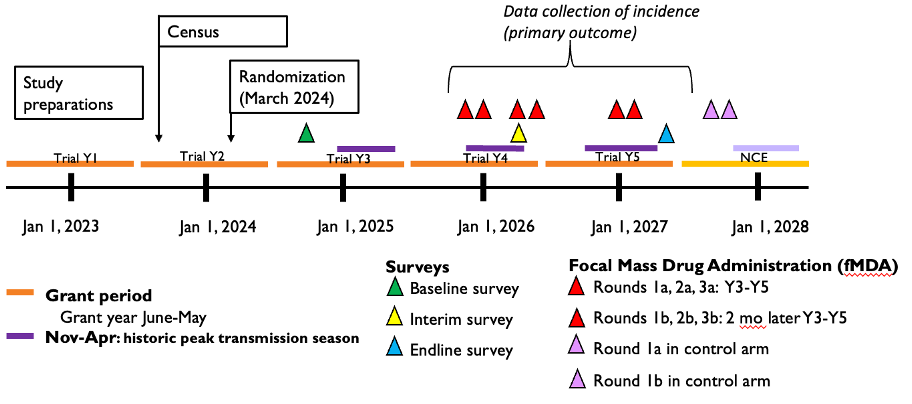
In addition to fMDA in the intervention arm, all enrolled participants in both arms are invited to participate in three surveys: baseline, interim, and endline (Figure 1). All participants enrolled in the study participated in the baseline survey. Out of the 2759 participants screened in Arm A, 70.6% (n=1950) participated in the interim survey while in Arm B, out of the 2072 participants screened, 69.9% (n=1449) participated in the interim survey. The final survey will take place in early to mid-2027.
Malaria incidence, for the purpose of fMDA implementation among high-risk participants, is calculated based on laboratory-confirmed, locally acquired P. vivax cases reported from health facilities within the study area. To date, 377 malaria cases have been recorded in FLAME participants. Local incident case data is triangulated from FLAME case report forms, records in fever journals kept at health facilities, and a national digital health registry called Notiweb.
The outcomes of the FLAME trial will inform future studies on the feasibility of implementing fMDA in P. vivax low-transmission settings, along with understanding the safety, efficacy, and cost-efficacy of implementing fMDA in these contexts. To date, the FLAME team has successfully conducted two large-scale population-wide surveys, sustained continuous collection of incident cases of malaria for 2 years, distributed antimalarial medication to thousands of participants, and begun to publish study findings.
How to learn more about FLAME:
- Universidad Peruana Cayetano Heredia, FLAME’s primary collaborating institution, recently published notas on their website, explaining the study’s premise, an anecdote from a field medic, and large-scale updates on progress.
- FLAME protocol paper
- Associations between weather and Plasmodium vivax malaria paper
- Listing on clinicaltrials.gov
Our Partners
